This article will serve as a guide to help you confidently master everyday communication situations in Japan.
1. The Art of Bowing (Ojigi) – More Than Just a Greeting
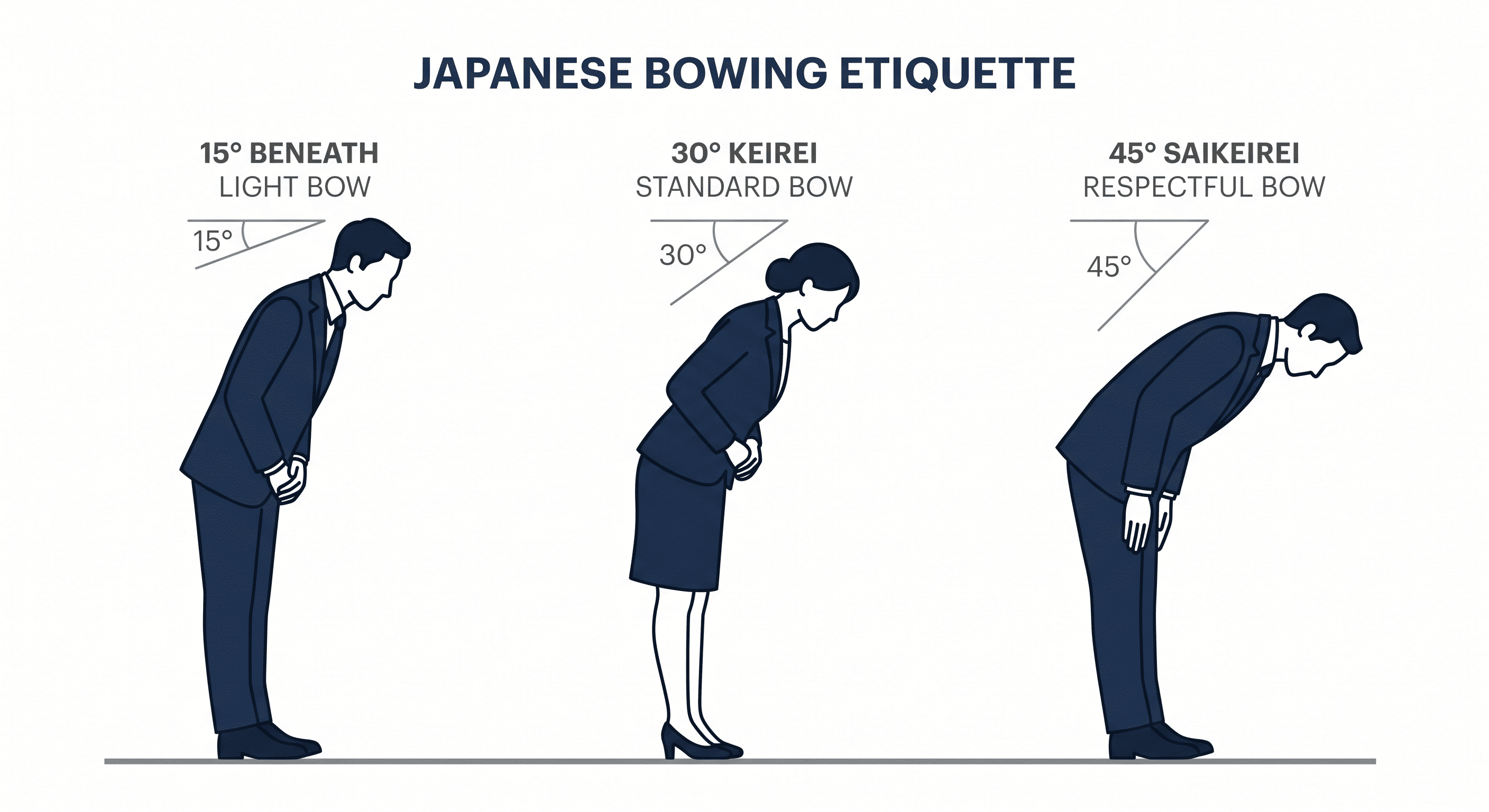
In Japan, the act of bowing (Ojigi - お辞儀) is not simply a polite nod, but a measure of respect, gratitude, and even a person's cultural values. Depending on the person and the context, the angle of the bow is divided into three different levels:
- Eshaku (Slight bow - approximately 15 degrees): This is the most common type of bow in daily life. You can use it when meeting peers, colleagues of the same rank, or when casually passing each other in the company hallway.
- Keirei (Formal bow - approximately 30 degrees): This type of bow is reserved for the workplace or when communicating with older people. You will use this when greeting superiors, partners, clients, or teachers.
- Saikeirei (Deep respect - Bowing 45 to 60 degrees): This is the lowest bow, expressing boundless gratitude or the deepest apology (謝罪 - Shazai) when you have committed a serious mistake.
2. Decoding the Power of "Sumimasen"
If you had to choose one Japanese word that appears most frequently in a day, it would definitely be "Sumimasen" (すみません). Foreigners often translate this word as "Excuse me," but in Japanese etiquette, its meaning is much broader.
Japanese people tend to avoid inconveniencing others (Meiwaku). Therefore, "Sumimasen" is used as a natural reflex in three main contexts:
- Excuse me: When you accidentally bump into someone on the subway or make a small mistake.
- Thank you: When someone holds the door for you or offers you a seat. Japanese people say "Sumimasen" with the meaning: "I'm sorry for inconveniencing/wasting your time by helping me; I'm very grateful."
- Attracting attention: When you want to call a waiter in a restaurant or ask a passerby for directions (similar to "Excuse me" in English).
3. Unwritten Rules When Using Public Transportation
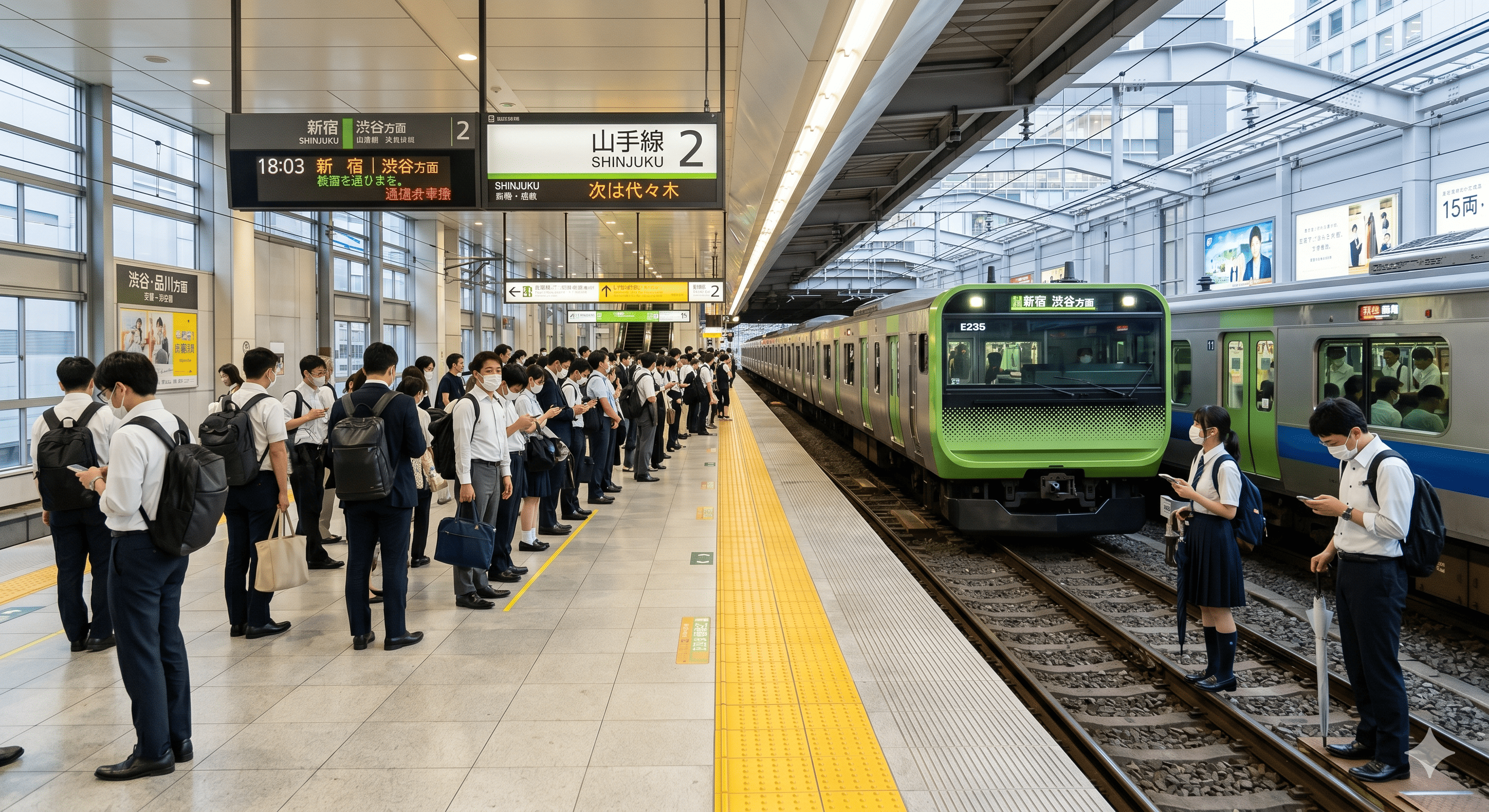
Japan's public transportation system (subway, Shinkansen, buses) is famous for its precision down to the second. To maintain that order, there are unwritten rules that anyone boarding a train must follow:
- Absolute silence: The Japanese consider the space on the train a shared space requiring quiet so that people can rest or read. You should not talk loudly or make phone calls while on the train.
- Switch your phone to silent mode (Manner Mode): If you receive a call, hang up or text back that you are on the train and will call back later.
- Etiquette of giving up seats: Train carriages always have priority seating areas for the elderly, pregnant women, and people with disabilities. Even if there are empty seats, if you don't belong to one of these groups, please refrain from sitting there if the train starts to get crowded.
Queueing respectfully: Always queue along the lines marked on the platform to wait for the train. Wait for all passengers to disembark before boarding; absolutely do not push or shove.
4. Punctuality – A Measure of a Person's Credibility
In Vietnam, the concept of "flexible time" might sometimes be tolerated, but in Japan, being late is a major "offense" in communication, especially in the workplace.
The 10-Minute Rule: For appointments, interviews, or work hours, arriving 10 minutes early is considered on-time. Arriving right at the last minute or even exactly on time is sometimes considered rushed and unprepared.
How to Handle Being Late: If there is an unavoidable incident (such as a train delay due to weather), you must immediately call or text the other party before the scheduled time, clearly stating the reason and your expected arrival time. Don't forget to ask for a delay certificate at the station as proof.
5. Things to Avoid (For Tourists)
To have a pleasant trip and be well-liked by the locals, remember these actions that are considered impolite:
Eating while walking: Japanese people often buy food and eat neatly right next to convenience stores (Konbini) or vending machines, then throw the trash in the bin right there. Holding an ice cream cone or skewer of meat while walking on the street is considered impolite and easily soils others.
Pointing directly at someone's face: This is considered rude. When giving directions or inviting someone, Japanese people will hold their palms up and point towards that person/object.
Littering: Japanese streets are extremely clean despite the scarcity of public trash cans. People here have a habit of taking their own trash home to sort and dispose of it.
Conclusion
Learning how to communicate and behave in the Japanese style is not about being constrained, but about learning to respect the collective living space and demonstrating one's own refinement. "When in Rome, do as the Romans do." Just by observing a little and always maintaining a polite attitude and a smile, you will surely receive warm assistance and positive impressions from the people here.